
Collective bargaining wish list...
It's gotten very little attention, but according to the Associated Press the NBA and the player's union have already begun collective bargaining talks in advance of the current collective bargaining agreement (the CBA) which expires after the 2010-11 season.
The AP piece notes that the main point of contention (as it always seems to be) is how revenue will be split between the owners and players. But I have much broader concerns than the eventually agreed upon revenue split, such as guaranteed contracts, trades, the luxury tax line and age limits.
How this all pans out will affect owners, players and fans alike so it's not too early to discuss it, worry about it and let the voice of the fan be heard. Because if the talks stall or reach an impasse resulting in another lockout, it's the fans and the employees who depend on the NBA who ultimately get screwed. Not the multi-billionaire owners or the multi-millionaire players.
One way or the other, the next CBA will look different from its current version which anyone associated with the NBA would admit has its flaws. Before targeting what's wrong and needs to be fixed with the CBA, let's point what's good about it. (By the way, if you'd like to become an expert on the particulars of the current CBA and are up for a lot of legal reading this weekend, you can read the entire agreement here.)
From a macro perspective, even though this flies in the face of all my capitalistic principles I'm glad the NBA has limits on how much players can get paid and how much teams can spend with some flexibility. While it may not be great for TV ratings, it's great for the league as a whole that teams like the Nuggets and Spurs can - in theory -compete with the likes of the Lakers and Knicks who dwarf the smaller markets in revenue and market size. Like the NFL, in the NBA you're only as good as your owner and general manager. So if you're based in San Antonio and have a great owner and a great GM (in the Spurs case they have a great owner and two great GMs) you can out-duel a team based in New York who might have an awful owner and an awful GM (which the Knicks have had historically...the jury is out on what Donnie Walsh is up to).
Some may argue that the NBA's "soft cap" - whereby you can exceed the salary cap to re-sign your own players - only favors big markets, but I'd argue that it favors owners who are willing to spend, not necessarily big markets (see Clippers, Los Angeles and Sterling, Donald). I also appreciate the NBA's rookie scale. Year after year we witness the NFL's absurd process of getting rookies into training camp in time as their agents wait for the first pick to sign before setting the market for everyone else drafted. Simply put, Knowshon Moreno doesn't hold out if he's drafted by the Nuggets instead of the Broncos.
That's the good. Now for the bad.
First off, the guaranteed contract in its present form must go. How many more Tim Thomas's or Darius Miles's or Erick Dampiers do we need to see to recognize that the guaranteed contract must be scrapped? The word on the street is that the owners will aggressively fight the union on it in this next go-around of negotiations. And they absolutely should. The Nuggets current situation with Kenyon Martin being owed $15.4 million and $16.5 million over the next two seasons is a textbook example of the guaranteed contract becoming an albatross for an entire organization. The Nuggets have an owner willing to lose money to bring Denver an NBA championship, a competent management team in place and a deep, talented roster that's just a solid big man away from possibly winning that championship. And yet because of K-Mart's deal, the Nuggets will be lucky to score a Jeff Foster-caliber center.
Like they do in the NFL, I'd like the NBA to move to a system where contracts are partially guaranteed and much of that guaranteed money is paid up front, giving players the incentive to play their hearts out and keep in shape when those non-guaranteed years kick in. For whatever reason, too many NBA contracts are backloaded for when players get older and less hungry. And at the very least, if the union insists on guaranteed contracts teams should have the right to cut one player per year, pay the player out but not have it count against the cap. I don't have an issue with encouraging owners and GMs to stay away from dumb contracts (like the one Joe Dumars gave Ben Gordon this summer), but I don't think owners - like the Nuggets Stan Kroenke or the Mavericks Mark Cuban - should be penalized for being willing to spend to reward their fans. The K-Mart trade-and-sign was a disastrous decision in hindsight, but it came from a good place: Kroenke wanted to reward Nuggets fans for supporting the team by adding an impact power forward. Why are we making owners suffer for that?
Secondly, trades need to be simplified. In order to make an NBA trade today, teams must swap salaries that are within 125% of each other plus $100,000. Throw in trade exceptions and non-simultaneous trades and completing an NBA trade can rival doing your taxes: it's an overly complicated system that no one really understands. I have no issue with salaries having to matchup to a point, but the difference needs to be higher than 125% plus $100,000 to give GMs more flexibility to make deals. Too many solid veterans are shipped around (see Smith, Joe) as contract fodder only to be cut and re-signed by the teams that dealt them in the first place. Why not allow trades to be within 200% and ditch the trade exception stuff altogether?
Thirdly, the luxury tax line needs to be raised. As a Nuggets fan I'm admittedly biased here, but it's not fair for Stan Kroenke to be asked to lose triple what the Lakers lose to put a similar product on the floor. If a small market owner like Kroenke is willing to shell out as many salary dollars as a big market owner like Jerry Buss or Cuban, why is he getting penalized so much for it? As reported a few months back, Kroenke allegedly loses about $10 million a season before the Nuggets exceed the luxury tax line. As of today, Kroenke is on the hook to pay out $76 million in player salaries - or $6 million over the $70 million tax line which means another $6 million goes into the NBA's coffers. So between the $10 million Kroenke allegedly loses plus the $12 million he'll be paying out in salary/to the NBA, this could be a $22 million loss. Conversely, the Lakers don't lose any pre-luxury tax line money and while I'm sure they'll say differently, I doubt between their ticket sales (double Denver's), TV and radio package (triple or quadruple Denver's) and sponsorship deals (also probably triple Denver's) they lose any money all - even when they exceed the tax line. Whatever percentage of basketball related income (BRI) the NBA is using to set the tax line needs to be adjusted.
Fourthly, the minimum age rule should mirror MLB's. The one-and-done rule by which kids have to play at least one year of college basketball or enter the NBA after the age of 19 has backfired on the NCAA. It should really be called one-semester-and-done because that's exactly what's happening. What's the point of having great coaches like Roy Williams or John Calipari or Ben Howland kill themselves to recruit and coach top prospects only to have those prospects jet off to the NBA after a semester on campus? Like baseball, I'd like to see the NBA scrap the age limit. If you're ready to come into the NBA - a la LeBron James, Kobe Bryant, Kevin Garnett, Dwight Howard, and so on - then they should be allowed in right away. And for those who stay in college, they should stay at least three years or wait until they're 21, as they do in Major League Baseball.
The catch to this last point is that while MLB has a great farm system, the NBA needs an actual farm system. We were getting there until some NBDL teams went broke during the recession. Because ideally, each NBA team would have its own NBDL team stocked with coaches and prospects of their choice. I've always wondered if Nikoloz Tskitishvili would have been as big a bust as he turned out to be had he played 40 minutes a night for the 14ers for a full year before competing in the NBA. Imagine an NBA where solid veterans get to keep a bench spot for an extra season or two while rookies and raw prospects play 40 minutes a night on an NBDL team or in college. The quality of basketball in the NBA would rival what we saw in the late 1980's.
As the NBA did when they negotiated the last CBA, let's hope the owners and players union get way ahead of it and we never even get close to a lockout. But as fans, we too must be vocal and let our voice be heard. Because as Nuggets fans are experiencing first hand, the system as-is cheats us out of celebrating our first NBA Championship.
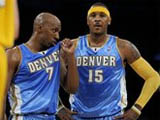
(Photo courtesy of Chris Carlson, AP)

3 recs |
15 comments
|
Comments
Guaranteed contracts
While I agree with some of what you’ve said, I disagree with not guaranteeing contracts. I think guaranteeing them is precisely what keeps us from being like the NFL with their crazy salary problems; most importantly, holdouts. If we don’t guarantee contracts, then players will start holding out when they feel their value has increased more than their salary. If we don’t stick to our contracts, they don’t have to stick to theirs, and that, my friend, is a dangerous game when dealing with young millionaires and their over-inflated egos.
What needs to change is when players like K-Mart and Nene miss significant time because of injury; it should not count against our team’s salary cap. Kroenke could still pay it, but that would allow us to go out and get a player to fill in while they’re out for 18 months with torn ACLs and Microfracture surgery.
I agree that it sucks when a player is signed to a huge contract and then doesn’t produce in the last couple years, but that’s the business. Contracts should also be frontloaded when you’re dealing with an aging star like Chauncey. There should be a bell curve that pays him more in his productive years than when he is 35 and going downhill fast.
What’s scary with all of this is that in almost every scenerio, the large-market teams have the advantage. If contracts weren’t guaranteed, just think what the Knicks would do every summer. All their dumb contracts are the only thing keeping them in the cellar every year.
by roscoe66 on Aug 7, 2009 2:40 PM MDT reply actions 1 recs
Injury Exception
The league does have the injury exception rule, but teams very rarely exercise the option. The main reason being that most players have multiple year contracts and the injury exception only applies to the period when the player is injured. Once the player returns, you now have two contracts that both count against the cap.
What Brian said
There is the injury exception rule precisely for what you mention roscoe. It’s just, as Brian said, that most teams choose not to use it because the injury exception rule works just like the trade exception rule (in that you must take on a full salary in trade to utilize the injury exception). Read more on this if you like.
No mistakes in the tango, darling. Not like life. Simple. That's what makes the tango so great. If you make a mistake, and get all tangled up, you just tango on.....
Rookie Pay
I couldn’t agree with you more on the pay scale for draft picks / rookies. This has been the best move the NBA has made to eliminate salary negotiations for players in the first three years. It also just about guarantees a team will be able to draft a player and retain that player for at least three years (if they want to keep the player). I think the rookie pay scale is the #1 priority for the NBA to retain in the new CBA. What other league has all of their top draft picks dressed and playing for their new team within two weeks of the draft? Granted, it is just summer league, but it works amazingly well. NBA players are now forced to prove their value in the league before they take on a max contract. Mistakes are still made by less-than-savvy GMs, but I don’t think a better system exists in any other professional sports league.
Get rid of that 1 year college rule
One last post for now on this topic, I promise.
I agree as well about the 1 year college rule. Time to get rid of that rule. It was a failed experiment and in retrospect has added no real value to the NBA game. Brandon Jennings going to Europe for a year just because the NBA wouldn’t allow him in the draft is a complete joke and honestly, an embarrasment to the league. Brandon Jennings came back, but what happens some year when the next Lebron James goes to Europe for a year and never returns to play in the NBA?
Guaranteed contracts
The guaranteed contract rule in itself is not bad, but it probably gives the players too much leverage once their value has hit a certain point or they are at a peak in their career. The bidding war that ensues leads to agents milking stupid GM’s and generous owners into mortgaging their future. One way to modify it is to make all player options partially guaranteed, or unguaranteed. Also, raising the luxury tax line would benefit the Lakers A LOT more than it would the Nuggets, just sayin…
Steven Hunter just got traded to Memphis for a protected 2010 1st rd pick. No picks in 2010 now, yay
by runningdonut on Aug 7, 2009 3:09 PM MDT reply actions 1 recs
I first saw it on twitter
yahoosportsnba put it up and it should on yahoo now
Denver Post just reported it too
http://www.denverpost.com/nuggets/ci_13016643
Here this is the best link
http://www.hoopsworld.com/Story.asp?story_id=13535
The nugs get another trade exception. They gave a future 1st rounder so perhaps they do keep their own pick next year. Only 10 plays are signed now, Kleiza and Carter still up in the air
I wonder if a lockout occurs, just how long can the players hold out?
The notorious Bill Simmons has talked recently on his podcasts about NBA players living paycheck to paycheck … we just witnessed Antoine Walker bounce checks like he used to bounce basketballs all over Las Vegas.
I know Simmons isn’t a real news “source” but it’s an interesting point. The owners may have the edge on players in that regard.
The terrifying part is that if a long lockout did occur then it would disrupt the prime careers of Melo, LeBron, Wade, and pretty much ruin the tailend of Kobe, KG, and other vets. I don’t think the NBA can live with that happening …
Denver Stiffs.com: Defending the sovereignty of Nuggets Nation.
Guaranteed Contracts
Interesting stuff, nice article.
I have to disagree on the segment about guaranteed contracts. Abiding by the salary cap and finding the right players for the right value is part of what makes the NBA interesting. Sensible management is as important as coaching, team chemistry and player talent (in fact the latter three are all dependent on management).
Your right, it would have been nice if the Nuggets did not have to deal with K-Mart’s contract over the past 5 years. If we could have made his ridiculous salary go away we very well could have won a championship by now. The fact is Kiki made a terrible deal, knowing full-well the structure of the CBA, and the Nuggets have paid dearly for it. The Nuggets franchise is to blame, no one and nothing else. Also, K-Mart played well enough to convince Kiki (and only Kiki) that he was worth that kind of money. If NBA teams are allowed to simply cut a player in Kenyon’s situation and pay little to no consequence, it would be unfair to the player and also to the other teams in the league that make better financial decisions.
If you permit partially guaranteed contracts, or teams to simply cut a player when he is not convenient anymore, or allow teams to avert the salary cap because their owners "want to spend money", you open up the door for large market teams to absolutely dominate the rest of the league. This is what has happened in Major League Baseball. Teams with resources can more or less buy championships while the small market teams need luck to even compete.
by MeloNuggets on Aug 7, 2009 3:56 PM MDT reply actions 1 recs
+1
I totally agree with everything you said Melo. I’d like to make one point (before going off to write on my own blog about this very topic—thanks Andrew—I needed motivation) that if you lower the amount of money any team has to pay, you just make it that MORE profitable to be the Lakers and Knicks because they are only operating under their constraints of the league that has limited them. Yet, they might spend less money, and increase fan support because it’s not like they sell out games already.
In short, doing what you suggest Andrew makes the big market teams more profitable than they are now.
No mistakes in the tango, darling. Not like life. Simple. That's what makes the tango so great. If you make a mistake, and get all tangled up, you just tango on.....
Oh man (can't agree with some of this)
Guaranteed contracts? You know what, if the Nuggets didn’t sign Kenyon Martin to a stupid contract, they wouldn’t be paying him. Simple as that. (That’s equally true of the Kings with Beno Udrih regardless of the money differences.) That’s why I don’t have a problem with guaranteed contracts to begin with. I don’t like the NFL’s system of partial guarantee’s, and I like the current NBA salary cap as is. It’s not a terribly complicated system to understand once you understand it, but of course, most fans don’t.
Btw, not all trades use the 125% + 100K rule. That’s only if a team is over the salary cap. If a team is under the salary cap, like the Grizzlies, and like the Hunter trade, no 125% rule is necessary. Why is it that despite the usefulness of having cap room, so many teams stay over the cap? Because it isn’t that useful to begin with!
I agree with your point about the age limit being bogus, and I, too, would like to see a farm system as well. The NBDL is well on it’s way.
On an overall note, I blame the owners for the way they pay players. It’s not Stan Kroenke’s fault that he’s in Denver, but that isn’t an excuse. He bought into the league, and the Nuggets, when they were in Denver and when the Lakers were making money hand over fist. Frankly, I think too many fans excuse owners for being stupid idiots and not knowing what they get themselves into. I find it unfortunate, but it is what it is.
I personally hope the owners get their way. Players will get screwed, and than the owners will complain when they can’t improve their team because of their own stupid restrictions in the first place. I can’t wait for that. Really can’t.
No mistakes in the tango, darling. Not like life. Simple. That's what makes the tango so great. If you make a mistake, and get all tangled up, you just tango on.....

by